


Digital microscopes
Digital microscopes with a built-in screen, so you look at a display rather than through an eyepiece and can save what you see as photos and video. They cover roughly 20x to 500x, which is the range for coins, stamps, plants, insects, fabric, print and circuit boards. Our current models are the Levenhuk DTX 350 LCD, with a 4.3-inch screen, and the Levenhuk DTX 500 LCD, with a 5-megapixel camera and measurement software. Both run on a rechargeable battery as well as USB power, and both are dispatched from our warehouse in Northern Ireland.
Free UK delivery on orders over £100, delivery charge shown at checkout
-
Levenhuk DTX 350 LCD Digital Microscope
Regular price £151.95Regular price -
Levenhuk DTX 500 LCD Digital Microscope
Regular price £227.95Regular price -
Bresser LCD 50-2000x Digital Microscope
Regular price £210.95Regular price -
Levenhuk DTX 700 LCD Digital Microscope
Regular price £278.95Regular price -
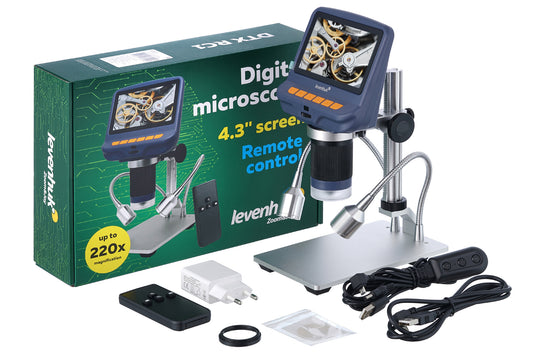
Levenhuk DTX RC1 Remote Controlled Digital Microscope
Regular price £151.95Regular price -
Levenhuk Rainbow DM500 LCD Digital Microscope
Regular price £151.95Regular price






Why a screen model rather than a USB microscope
A USB microscope is a camera on a stick that needs a laptop to show you anything, and the cheap ones have no stand worth the name, so the image shakes every time you touch the table. A digital microscope with a screen has a proper stand with a focus wheel, its own display, and a memory card slot, which means it works at the kitchen table, on a workbench or in a classroom without any other kit. For adults looking at coins, electronics or plants, it's the better buy almost every time. Our best digital microscope guide goes through the trade-offs in detail.
What to look for
Four things separate a good digital microscope from a disappointing one. The first is the real optical range rather than the headline number, which is why our product pages give the range as the manufacturer states it. The second is the stand, since a stage with clips and a scale makes measuring and repeat viewing far easier. The third is the camera sensor, where 5 megapixels gives you photos worth keeping and 0.3 megapixels is fine for the screen but soft when saved. The fourth is lighting you can dim, because coins and polished metal glare under full brightness.
Which model for which job
The DTX 350 is the one to choose if you want the bigger screen and a long battery life for looking rather than recording. The DTX 500 is for anyone who wants to photograph, measure or film what they see, and for soldering and inspection work, where its 150 mm of focus travel gives you room to get tools underneath. Both sit in the £150 to £250 bracket.
Digital microscope FAQs
Can a digital microscope look at cells and slides?
Not well. These models light the sample from above and are built for solid objects. For prepared slides and pond water you want a compound microscope.
Is 1000x on a digital microscope real?
Usually it's a combination of optical magnification and digital zoom, and the digital part adds no detail. Our magnification guide explains how to read the numbers.
Do they work with a computer?
Yes. Both of our models connect over USB to a Windows or Mac computer, and the DTX 500 also has an AV output for a television or projector.
Not quite right?


